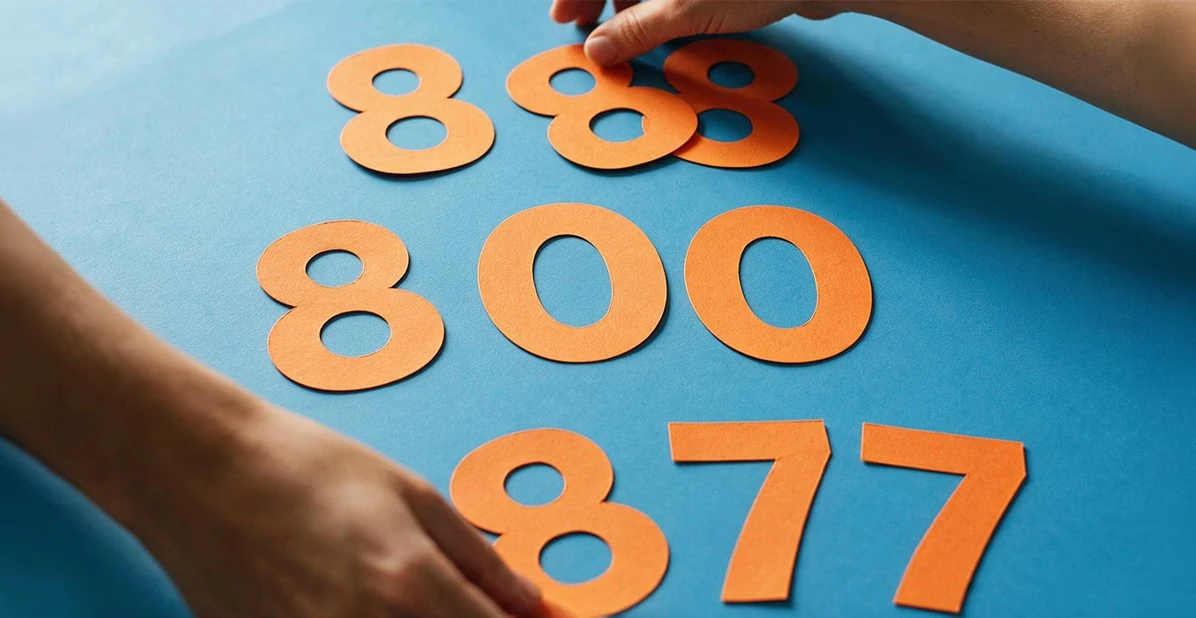
Every toll-free prefix connects calls the exact same way, so why does an 800 number cost more than an 888 or 877? We break down what's actually different, and when it's worth paying for.
Short answer: for how the number works, no. For how it reads, yes, and that difference is exactly why 800 numbers command a premium while 888 and 877 numbers don’t. If you want the full picture on why true 800 numbers are so limited in the first place, that’s covered in depth separately, this post focuses specifically on how 800 stacks up against the newer prefixes.
Functionally, they’re identical
Short answer: for how the number works, no. For how it reads, yes, and that difference is exactly why 800 numbers command a premium while 888 and 877 numbers don’t. If you want the full picture on why true 800 numbers are so limited in the first place, that’s covered in depth separately, this post focuses specifically on how 800 stacks up against the newer prefixes.
So why does 800 cost more?
Two reasons, and neither is technical:
1. It’s the original. 800 has been the toll-free prefix since the concept existed. Every prefix that came after, 888 in 1996, 877 in 1998, and the rest that followed, was introduced specifically because the 800 pool had run out of room. That sequence is part of why 800 still reads as the “real” or most established option to a lot of customers, even decades later.
2. There’s a hard ceiling on supply. New 888, 877, or other prefixes can theoretically be introduced if demand requires it, and the toll-free industry has done exactly that several times. There is no equivalent path for 800. What’s in circulation is close to the entire population that will ever exist, cycling through licensing and release. Scarcity, not performance, is what sets the price.
Where the prefix actually moves the needle
- Print and broadcast. An 800 number read aloud on a radio spot or printed on a billboard still tests as the most immediately recognizable format.
- Brand perception in “trust-heavy” industries. Financial services, legal, healthcare, and franchise operations often see outsized value in the “we’ve been established a long time” signal.
- Investment/resale value. Because 800 numbers can’t be replenished, well-chosen ones tend to hold or increase in perceived value over time in a way newer prefixes don’t.
If prefix prestige isn’t a priority for your brand, an 888 or 877 number will do everything an 800 number does, usually at a lower price with more available options to choose from. If your brand leans on maximum credibility signaling, or you specifically want a number that reads as established the moment someone hears it, the 800 prefix is the one to prioritize, with the caveat that available inventory is limited and pricing reflects that scarcity.