Each one lands in the same place: your customer’s native texting inbox, under your verified brand name and logo rather than an anonymous number.The naming can get confusing, because carriers label these types differently by region – “Rich” and “Rich Media” in the U.S., “Basic” and “Single” almost everywhere else. Underneath the labels, the choice is simple: how rich does this message need to be, and do you want a one-way notification or a two-way conversation? And here’s the good news – if you already send SMS, you’re most of the way there, because RCS reaches the same native inbox and falls back to SMS automatically.In this guide, we’ll break down what RCS message types are, walk through all three, compare them side by side, unpack the interactive building blocks, and show you how to choose – with real examples from brands already doing it.
Table of contents
1. What are RCS message types?
2. The three types of RCS for Business messagesBasic messages: your SMS, upgradedSingle messages: rich, interactive, one-wayConversational (session) messages: two-way at scale
3. RCS message types compared
4. The building blocks of RCS messages
5. RCS branded messages and verified sendersWalk, run, fly: building up your branded messaging
6. RCS message types in actionBasic messages: EasyPark builds a secure driver experienceFrom Single message to conversation: Nespresso inspires with rich, interactive content
7. How to choose the right RCS message type
8. Frequently asked questions about RCS message types
9. Get started with RCS for BusinessType your paragraph here
Rich Communication Services (RCS) is the messaging standard created by the GSM Association (GSMA) under its Universal Profile to modernize SMS and MMS. Google is its biggest implementer – Google Messages is the default RCS app on Android – but the standard itself belongs to the mobile industry, not to any single company.
RCS for Business (previously called “RCS Business Messaging” or “RBM”) is the application-to-person (A2P) side of that standard: the branded, verified messages a company sends to its customers. Because RCS supports everything from a plain text alert to a swipeable product carousel, carriers and platforms group those messages into types – each with its own capabilities, character limits, and billing model.
Think of the types as a ladder. At the bottom is a simple, verified text message that looks a lot like SMS; at the top is a full two-way conversation with rich media, interactive buttons, and AI-driven replies. What stays constant at every rung is that the message arrives from a verified sender profile – brand name, logo, and badge – in the native messaging app, no download required. RCS now reaches roughly 1.5 billion users globally, including 250 million in the U.S., where more than a billion RCS messages are sent every day.
Most carriers and platforms organize RCS for Business messages into three functional types. The labels shift by region, but the capabilities line up cleanly.
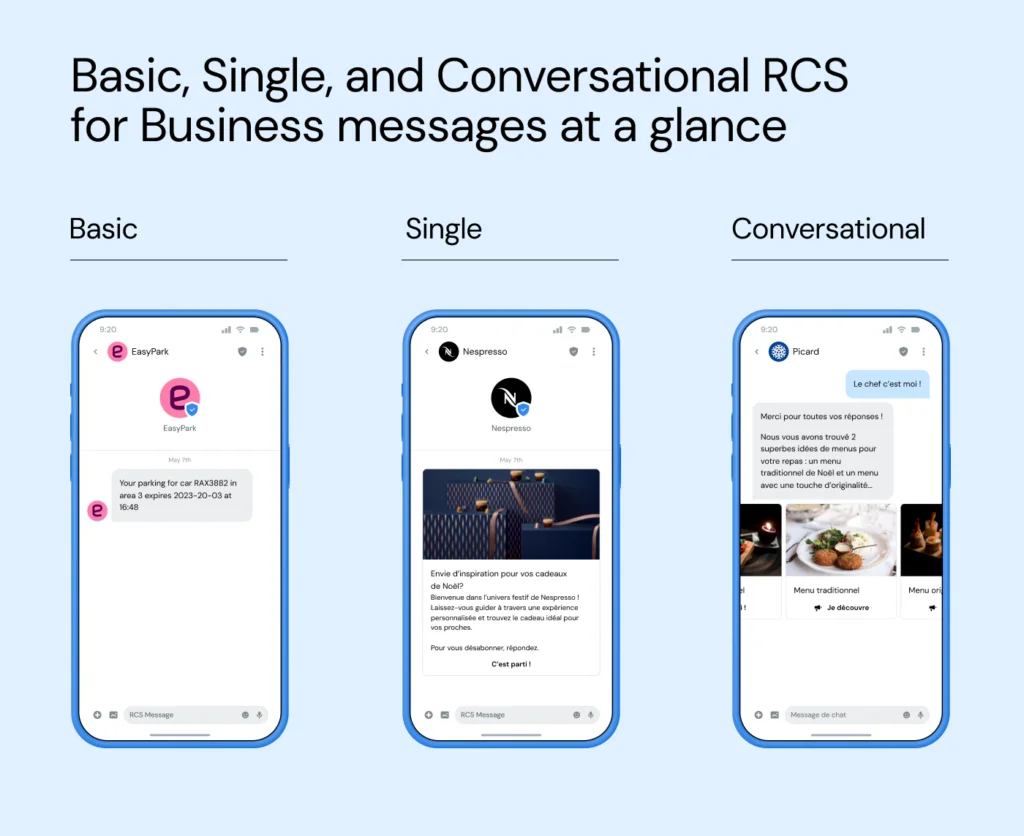
A Basic message is the entry point – text only, up to 160 characters, sent from a verified, branded sender, with URL previews that show recipients where a link leads. U.S. carriers usually call this a “Rich” message.
Basic messages are perfect for one-off notifications that don’t need a reply: one-time passwords (OTPs), delivery updates, appointment confirmations, and limited-time offers. The upgrade over SMS is trust, not flash – the same alert, now clearly from you, with a branded profile instead of a mystery number. Because they map so closely to SMS, they’re also the easiest first step: if your backend already handles text, you can start here with almost no new integration.
A Single message is where RCS starts to feel like an app. It carries text beyond 160 characters plus rich media – images, GIFs, videos, rich cards, and carousels – along with suggested replies and suggested actions like opening a link, dialing a number, or dropping a pin on a map. U.S. carriers call this a “Rich Media” message.
A craft note on carousels, learned the hard way by teams migrating from MMS: don’t treat the format as one big image with everything crammed in. The campaigns that perform pace the story across cards – the first card earns the swipe like a teaser, and each card that follows advances one chapter of the offer until the last one carries the call to action. Carousels also update in minutes when an offer changes, which is exactly where video assets – slow to re-edit – tend to fall behind the business.
Single messages are still one-way: you send, the customer sees a visually engaging message, and they can tap a button to act. That makes them a natural fit for marketing campaigns, product showcases, and promotions where visuals do the selling – RCS marketing campaigns deliver 3 to 7 times higher click-through rates than rich SMS, and interactive campaigns can lift average order value by nearly 10%.
The third type is the one the ladder is built toward: conversational messages. Here the message opens a genuine two-way thread. The customer replies, and your brand – or an AI agent – responds inside the same inbox, handling everything from product questions to returns to support triage.
This matters more than it sounds: in Sinch research, 28% of consumers say one-way messages frustrate them when they can’t interact or ask a question. Conversational RCS answers that directly. It’s also where billing changes – when a customer replies and your brand responds, a 24-hour session opens, and pricing typically shifts from per-message to per-session. Whether a message is conversational is defined by the agent type you register – non-conversational for one-way sends, conversational for two-way sessions – rather than by the format itself.
Here’s how the three types stack up on capabilities, billing, and best-fit use cases.
A quick word on pricing: billing follows the RCS Agent you register – a non-conversational agent bills messages individually, much like SMS, while a conversational agent bills per 24-hour session, so an active conversation isn’t charged per back-and-forth.
What makes Single and conversational messages feel app-like isn’t the “type” – it’s the interactive components inside them. These are the pieces you’ll actually design.
The one component that appears in every type, from Basic to conversational, is the verified sender profile – which is worth its own section.
Every RCS for Business message, regardless of type, is a branded message – that’s built into the protocol. Before you can send anything, your brand’s verified sender profile is vetted and approved by Google and mobile network operators; once it’s live, recipients see your official name, logo, brand color, and a verification badge at the top of the conversation.
Why does that matter so much? Because trust in mobile messaging is fragile. Our State of customer communications research shows that 53% of consumers have received a legitimate brand message in the past year that they initially found suspicious. Verified RCS profiles close that gap: nearly 80% of consumers say visual indicators like a logo or checkmark make them more likely to trust a sender, and 59% of industry leaders familiar with RCS say it will be game-changing for customer communications.
You don’t have to launch every message type at once. The brands that get RCS right tend to grow into it in three phases:
So what does this look like in the real world? Two brands show the range – one at the Basic end of the ladder, one further up.
EasyPark Group, a leading digital parking app, relied on multiple vendors to send SMS parking reminders across dozens of markets. After consolidating with Sinch, the team upgraded those SMS reminders to RCS Basic messages for RCS-capable devices.
The payoff was trust. Drivers on Android now see the verified EasyPark brand as the sender and know the reminders are genuine – no small thing when 75% of organizations report SMS phishing attacks (Proofpoint’s 2024 State of the Phish). For drivers without RCS, nothing changed: they still receive SMS reminders, so every driver stays informed thanks to automatic fallback.
Nespresso, the premium coffee brand, wanted to guide French customers toward its subscription program. It led with a Single message – a striking visual and concise copy – whose suggested replies opened into a guided, chatbot-led conversation.
The result? That conversational experience earned a 15% click-through rate and a 36% completion rate – and generated 2.3 times more completions than the Rich SMS fallback. The visuals and interactive buttons did the heavy lifting, and every reply became an opening for deeper engagement.
Weighing the types for your own program? Keep these factors in mind.
The message-type question comes down to one thing: matching the format to the job. Basic messages upgrade your alerts with trust and branding. Single messages bring the visuals and interactivity that drive campaigns. Conversational messages turn a broadcast into a relationship. And a verified sender profile makes every one of them unmistakably yours.
The brands seeing the strongest results didn’t wait for the perfect strategy – they upgraded one SMS campaign, learned, and scaled. With RCS reaching more inboxes every month across a market projected to grow from around $3 billion in 2025 to roughly $9 billion by 2030, there’s real upside in starting now.